Welcome, Demo! — Sign out

Season-Long Fantasy Football |
|


| Home → Rules → Games |

Choose From a Variety of Fantasy Football Games
DataForce Fantasy Football offers a wide variety of games from which you can choose. All of these leagues are season long or longer, and whatever your flavor, we have it. Most leagues have twelve teams (some have ten or fourteen), and most play head-to-head each week, where the team that scores more points wins the game. Some formats, such as Draftmaster, Guillotine and Playoff leagues, are decided by total points instead. All leagues share the same rules for player scoring.
What Is a Redraft League?
These leagues are called "redraft" because you draft a new team every year. We just call these "single-year leagues", and this is the most common choice. Owners take turns selecting players during the draft until each owner has a full roster of real-life NFL players (18 in a standard league; other lineup formats have more or fewer). Then, each week of the NFL season you select players to be in your starting lineup, and these players contribute to an overall game score. We have several different lineups for you to choose from.
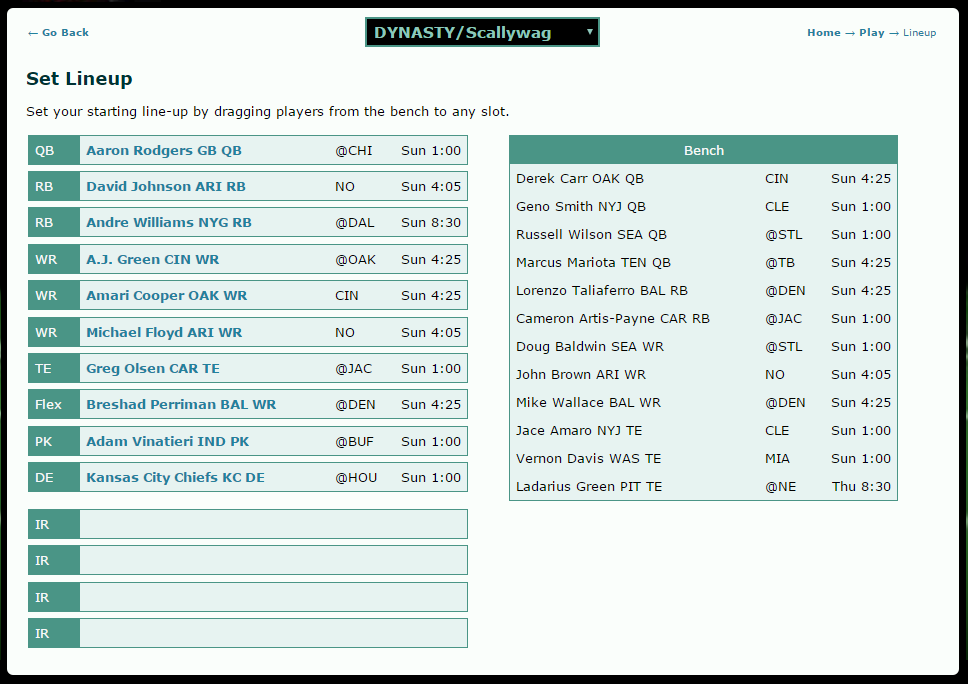
There are other decisions you must make each week as you manage your team. Here's a weekly fantasy schedule which describes how the game is played.
While regular redraft leagues remain the most popular format, there are many other options to choose from.
What Is a Bestball League?
Any league can be a bestball league, whether redraft or some form of multi-year league. "Bestball" simply means that you don't have to set lineups each week. The software constantly updates your lineup while the games are being played, so your highest-scoring players at each position are your starters.
For many people, the selection of starting players each week is an agonizing decision. Footballs bounce in crazy directions, so it's hard to guess which players will perform best each week, and one wrong guess can easily cost you the game. Bestball leagues remove the agony of choosing, while preserving team-improvement activities like waivers and trading.
What Is a Draftmaster League?
In draftmaster leagues, you don't have to make any decisions after the draft. No free agency, no trading, no setting lineups. Draftmaster leagues are bestball leagues: the software constantly updates your lineup during the games so your highest-scoring players at each position start. There are no head-to-head games or playoffs; prizes go to the highest season point totals. To make up for the lack of roster moves, you draft six extra bench players.
Draftmaster leagues are for owners who don't want to be bothered with the day-to-day maintenance of their leagues. Often called one-and-done leagues or draft-n-go leagues, it's possible to participate in many more simultaneous draftmaster leagues than other formats because owner involvement is over as soon as the draft ends. You can just sit back and enjoy the NFL season.
How Do Contender Leagues Work?
Want to aim a little higher than a twelve-team league? You're looking for a contender league, then. In this format, four leagues of twelve teams are joined at the hip. You'll play each of the other teams in your own twelve-team league, then a week-12 all-play, and then a one-week league playoff in week 13 to determine which four teams will advance further.
The four advancing teams then join the best teams from your three sister leagues to form a sixteen-team, four-week playoff race (weeks 14-17) competing for a grand prize, while the other teams play a Toilet Bowl over the same four weeks. This means you're essentially joining a 48-team contest, making for a more exciting prize fund.
Guillotine Leagues
Another form of redraft leagues that has grown popular recently is guillotine leagues. These are survivor contests, and they put your blind bidding skills to the test. In a twelve-team league, the first six weeks are an accumulation phase in which the top-scoring teams each week earn extra blind-bidding money, followed by eleven weeks of elimination (10- and 14-team leagues split the 17 weeks differently). During the elimination period, the lowest-scoring team each week drops out, and their players all go to free agency for the remaining teams to bid on. By the end of the elimination rounds, only one team is left standing to be league champion. There is no trading, and rosters have four fewer bench spots.
What Is a Keeper League?
"Keeper" leagues add a new dimension to the traditional fantasy league. In this format, you may keep up to five players from year to year, so your team continues to exist for as long as the league lasts.
We ask for an additional deposit when you purchase any multi-year team, equal to the entry fee for the league (double in Contract leagues), and this deposit roughly represents the value of your team. The deposit remains with the team in perpetuity. If you should one day have to leave the league, or if you just get tired of playing fantasy football, then your team becomes an orphan. You can list your team on our orphan marketplace at any price you choose. If it hasn't sold by the renewal deadline, it goes to the orphan auction. Instead of getting your deposit back, you receive the sale price (but if the auction draws no bids, later proceeds no longer go to you).
Since you are able to preserve five players from your team from year to year, strategies in keeper leagues tend to be long-range. You'll want to carefully watch the rookie market each year to look for players that might become superstars. You'll want to balance putting a strong lineup on the field this year with building a team for the future. Trading in these leagues becomes much more exciting, as you can trade draft picks not only for the current year but for the following year (rounds 1-10).
Each year a new draft takes place to let you replenish your team after dropping the players you decide not to keep.
In the end, though, it's all about winning. The best head coach will still win the Super Bowl and take home the biggest prize.
What Is a Dynasty League?
Ready to take it to the next level? These leagues offer the chance to build a true dynasty out of your team, since there are no limits to how many players you can retain from year to year. Keep a few or keep them all, and in the annual draft (held by email), you'll choose just enough players to bring your roster back to full strength.
There are a couple of other differences that make dynasty leagues a step more intense than keeper leagues. For one, your roster sizes are a little bigger, so you can hang on to a few more potential superstars. For another, you can trade future draft picks two years in advance rather than just one (one year in limited-trading leagues).
Because owners in dynasty leagues tend to grow attached to their teams, and because you're typically playing against the same owners from year to year, an atmosphere of camaraderie and friendly opposition often permeates the league.
Legacy Leagues
Dynasty leagues can last forever, unless you join a legacy league. This is basically a dynasty league which ends as soon as one team manages to win two league championships. Then the league ends, and the owner of that team goes home rich. Unless it's a Supertrader league, future picks can be traded only one year in advance.
It works like this. Half of your prize fund each year, plus every owner's initial deposit, goes into a purse. The other half is used to pay annual prizes. The purse continues to build each year until someone wins their second Super Bowl. It can take from two to thirteen years, but the longer it takes, the more money is waiting for someone to take it all.
Salary Cap Leagues
These leagues have a different flavor. They always start with an auction rather than a draft. In this way, each player on each team is assigned a salary equal to the amount paid at auction.
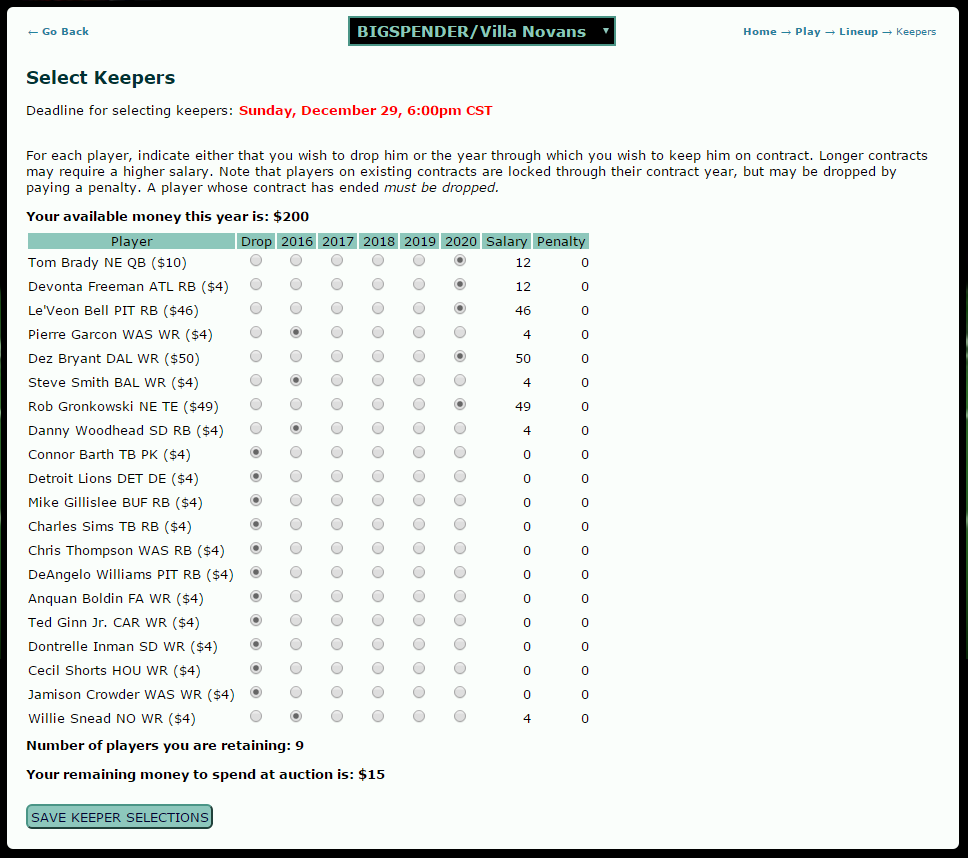
You may not carry player salaries totalling more than $200 on your team. If you drop a player and bid on a new player during waiver wire processing, you may not bid more than the available salary cap room for your team. Players picked up on free agency have a salary of just $1.
Salary cap leagues are multi-year leagues like dynasties, so you can choose which players to retain and which players to drop in the offseason each year. Instead of an annual draft, you'll participate in an annual auction, as you buy new players to fill out your team.
Because player salaries escalate a little each year, you can't afford to keep any player forever, but this is part of the fun. Each year you must make roster decisions to stay within your cap.
Contract Leagues
Ready now for the ultimate head coaching challenge? Try our signature format: a contract league. Like salary cap leagues, your players carry salaries from year to year. But this time, you award them multi-year contracts at a set salary for up to five years in the future.
Contract decisions are made in the offseason, when you'll decide which players to keep and for how long you want to put them on contract. Contracts are binding: you must continue to pay their salaries until the contracts expire, or pay a hefty penalty.
Contracts may be bought and sold. In fact, if you find a contract oppressive, you may actually pay another team owner to take a player and his contract off your hands. When you trade money in this manner, it decreases the money you have available for paying salaries in the next year, so you'll have less money to spend at the annual player auction.
Learn more about contract leagues, which run for ten years and require a double deposit.
Tin Babies and Twin Babies
Can't wait for draft season? Tin babies and twin babies are inexpensive leagues for off-season fun, offered from the end of the NFL playoffs through June. They make great draft practice, and you play them out during the following NFL season. Both are total-points leagues with no head-to-head games, no lineups to set and no trading, and part of the entry fee may be paid with bonus money.
Tin babies ($20) are drafted by email and come in two flavors: Draftmaster leagues, where you're done after the draft, and Bestball leagues, where you may add just one new player per week.
Twin babies ($10) have six contestants, each drafting two starters-only rosters (one red, one blue) in a draftmaster league. Prizes are paid in bonus money to the top red and top blue rosters, and if you win both, you can trade your winnings for a free Bronze-level playoff league.
Postseason Fantasy Football
The fun doesn't have to stop after the NFL regular season ends. You can continue playing fantasy football into January and February with playoff leagues.
In this format, only players on teams which made the NFL playoffs are available for drafting. You'll want to pick players from teams that you hope will go deep into the playoffs, because there are no weekly lineup decisions to make. Every player on your team contributes to your weekly score for every game that he plays in the NFL.
Playoff leagues have just six teams, every rostered player starts every week, and prizes go to the highest point totals.